


Do you rely on glasses or contact lenses every day? Many people wish they could see clearly the moment they wake up, without needing to reach for their glasses. However, they may become inconvenient or uncomfortable over time, especially for those with active lifestyles. Refractive eye surgery offers a way to correct common vision problems such as myopia (nearsightedness), hyperopia (farsightedness), and astigmatism, helping patients achieve greater visual independence.
Benefits of Clear Vision Without Glasses
Clear vision without glasses can make everyday activities feel simpler and more comfortable. Tasks that once required extra care or preparation no longer interrupt your routine.
Many people appreciate being able to see clearly while swimming or showering, without worrying about glasses or contact lenses. Activities such as relaxing at a spa or sauna, getting a haircut, or exercising become more convenient when vision is not dependent on external aids. Even unexpected moments, like being caught in the rain, can feel less troublesome when clear vision is maintained.
For those with active or busy lifestyles, reducing reliance on glasses can improve ease, confidence, and comfort in daily life. This is often a key reason patients explore laser vision correction options.
Understanding Refractive Errors and LASIK Surgery
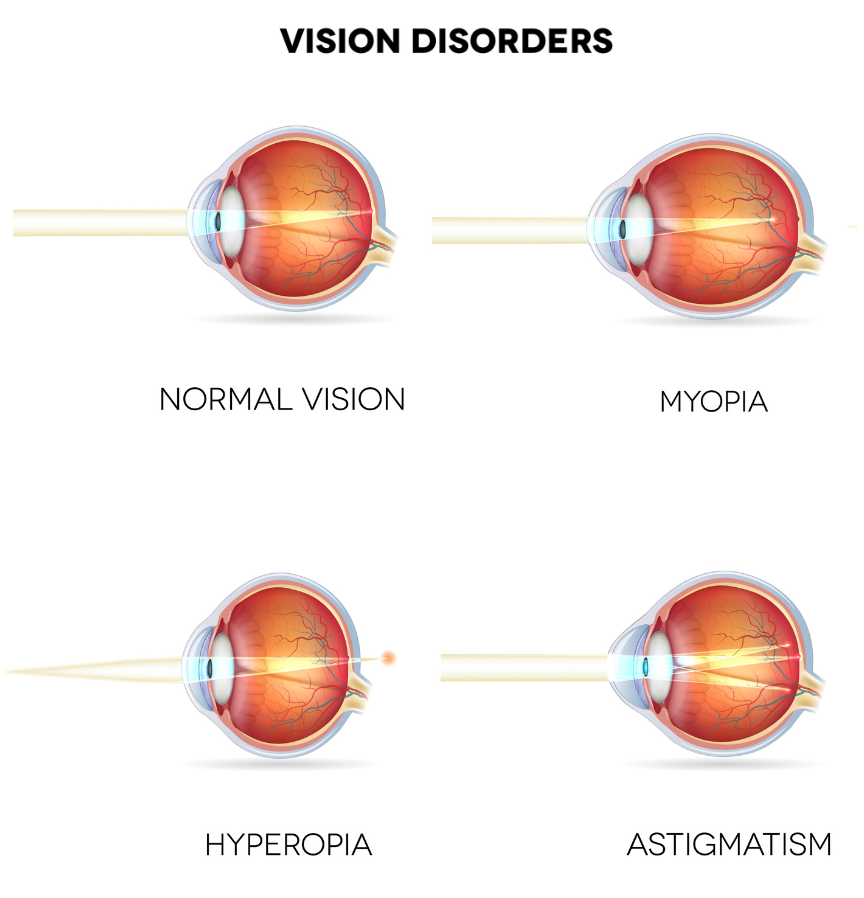
Refractive errors occur when the eye cannot correctly focus incoming light onto the retina, causing blurred vision.
Common refractive conditions include:
- Myopia (Nearsightedness): Difficulty seeing distant objects clearly due to a steeper corneal curvature, and/or longer eyeball length. Light passing into the eye comes to a focus in front of the retina.
- Hyperopia (Farsightedness): Difficulty seeing near objects clearly due to a flatter corneal curvature, and/or shorter eyeball length. Light passing into the eye comes to a focus behind the retina.
- Astigmatism: Blurred or distorted vision at all distances due to an irregular corneal shape. Light passing into the eye comes to a focus at more than one location on the retina, rather than at one point.
What are the Types of Refractive Surgery?
Refractive errors can be corrected with non-surgical or surgical methods, depending on the degree of vision problem and individual eye health.
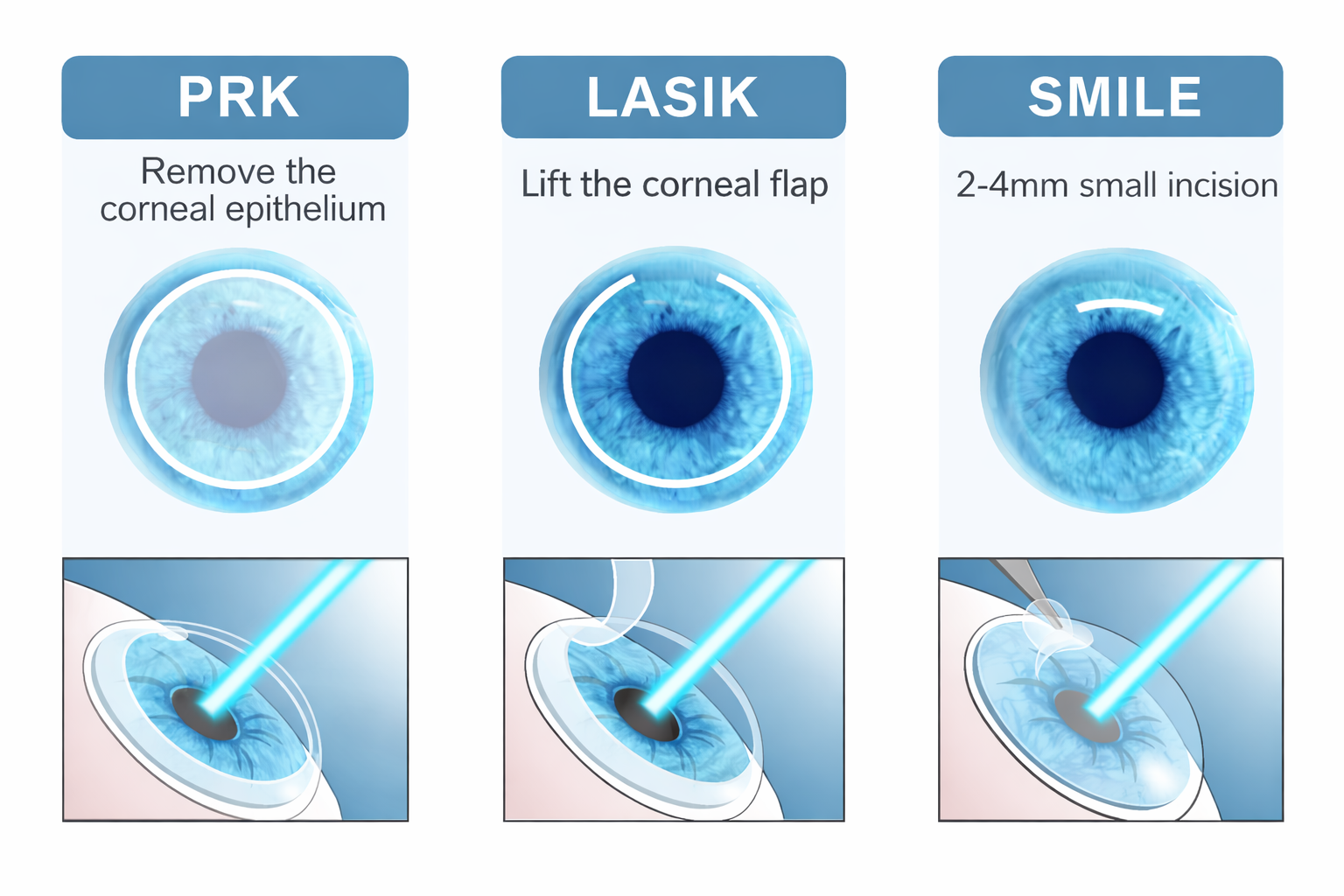
For many people, glasses or contact lenses remain the first step to correct refractive errors, some patients prefer a more permanent solution, especially if they experience discomfort, inconvenience, or dryness from long-term lens wear. In these cases, laser refractive surgery (or laser vision correction) are the treatment methods that correct corneal shape to restore clear vision, without glasses or contact lenses. There are 3 laser vision correction techniques available, each designed to correct refractive errors safely and effectively.
1. LASIK (Laser-Assisted In-Situ Keratomileusis)
LASIK surgery is one of the most trusted, established and widely-performed procedures for vision correction. It involves using a femtosecond laser to create a thin corneal flap, followed by a second step using an excimer laser to precisely reshape the underlying tissue so that light passing through the cornea focuses on the retina. The flap is then repositioned and the procedure is completed. Unlike older versions of LASIK where a microkeratome blade was required to create the corneal flap, the flap is now created with a femtosecond laser and thus the current, modern procedure is also known as “bladeless” LASIK. This restores clear vision for people with myopia, hyperopia, or astigmatism.
Procedure highlights:
- Completed around 25-30 minutes for both eyes
- Patients experience clearer vision within 1-2 days
- Performed under numbing eye drops only
- Minimal discomfort during the procedure
At Ascend Eye Clinic, we offer forefront and high-performance femtosecond and excimer laser technologies from leading manufacturers.
2. SMILE (Small Incision Lenticule Extraction)
SMILE LASIK, also known as ReLEx SMILE, is a newer form of laser vision correction that is flapless and minimally invasive. The procedure uses a femtosecond laser to create a tiny, lens-shaped piece of tissue (called a lenticule) inside the cornea, which is then removed through a micro-incision. By reshaping the cornea, SMILE corrects vision problems such as myopia and astigmatism.
Key Characteristics:
- No corneal flap creation, using only a small keyhole corneal incision to access the lenticule
- As no flap is involved, maintains more corneal structural stability, compared to LASIK
- Suitable for individuals engaged in contact sports, and active lifestyles, as no concerns on flap-related complications
- Quicker comfort and recovery compared to transPRK
- Current SMILE technology treats nearsightedness and astigmatism, but not farsightedness%
3. TransPRK (Transepithelial Photorefractive Keratectomy)
TransPRK, also known as “no-touch” laser vision correction, reshapes the cornea without creating a flap or making any incision. The laser removes the outermost layer of the cornea before correcting the corneal shape to improve how light focuses on the retina. At the conclusion of the procedure, a bandage contact lens is placed to aid in epithelial healing. The contact lens will be kept on for 1 week, and after healing is complete, it is removed.
Key Characteristics:
- Fully contact-free procedure, with no physical instruments touching the cornea
- No flap and no blade, all-laser surface ablation procedure
- Suitable for individuals with thinner corneas who may not qualify for LASIK or SMILE, or who engage in contact sport or physically active lifestyles, when flap-related risks are higher, or who just prefer a non-flap procedure
- Less dry eye than LASIK
- Longer recovery period to functional vision (1-2 weeks), with vision improving over 2-3 months
- May be indicated over LASIK or SMILE in individuals who have deep-set or small eyes where LASIK or SMILE is technically more difficult
Comparison between LASIK, SMILE and transPRK
| Feature | LASIK | SMILE | TransPRK |
|---|---|---|---|
| How it works | Corneal flap technique: a thin flap is created in the cornea | Lenticule technique: a small disc of corneal tissue is removed through a tiny corneal opening | Surface laser technique: topmost corneal layer is removed, and laser reshapes the cornea to the desired curvature |
| Incision / flap | Yes, a corneal flap is created | No flap, only a small incision | No flap or incision |
| Comfort after surgery | Usually mild discomfort | Usually mild discomfort | Slight discomfort in the first few days |
| Visual recovery | Fast, often within 1–2 days | Fast, within 1-2 days. Achieves functional vision in 1-2 weeks, with vision improving over 2-3 months | Slower, vision improves gradually over 1–2 weeks |
| Suitable for | Wide range of prescriptions with adequate corneal thickness | Individuals with suitable corneas who prefer flap-free surgery | Individuals with thinner corneas, active lifestyles, or who prefer no flap or incision |
| Range of refractive errors | Myopia: up to -15.0 D, hyperopia: up to +6.0 D, and astigmatism: up to -6.0 D | Myopia: up to approximately -10.00 D and astigmatism: up to -5.00 D | Myopia: up to -10.0 D, hyperopia: up to +6.0 D, and astigmatism: up to -6.0 D |
| Follow-up visits* | 3-4 follow-ups | 3-4 follow-ups | 4-5 follow-ups |
*Schedule of follow-up visits are adjusted for out-of-town patients
Pros and Cons of LASIK, SMILE, and TransPRK
Each laser vision correction method has its own strengths and limitations. Understanding these differences helps set realistic expectations and supports informed decision-making after an eye assessment.
LASIK
Pros
- Clear vision usually returns quickly, often within one to two days
- Individuals experience only mild discomfort after the procedure
- Suitable for correcting a wide range of prescriptions: nearsightedness, farsightedness and astigmatism
Cons
- Involves creating a thin flap in the cornea
- Not recommended if the cornea is too thin, or if there are surface conditions (e.g. excessive dry eye)
- Some patients may notice temporary dry or gritty eyes during early recovery
SMILE
Pros
- Less dry eye than LASIK
- No large surface flap is created
- Only a small opening is made, which may be preferred by individuals concerned about flap-related issues
- Suitable for most prescriptions of shortsightedness and astigmatism
Cons
- Vision takes just slightly longer to stabilise, compared to LASIK
- Cannot correct farsightedness
- May not be suitable for very high prescriptions or certain eye shapes
- Vision may take a little longer to stabilise compared to LASIK for some patients
TransPRK
Pros
- No flap and no incision are made
- Suitable for patients with thinner corneas or irregular eye surfaces
- Avoids flap-related considerations entirely
Cons
- Vision improves more gradually over days to weeks
- Discomfort is more noticeable during the first few days of healing
- Requires closer follow-up early on while the eye surface heals
Important note:
There is no single procedure that is best for everyone. Suitability depends on eye measurements, corneal health, refractive error, and daily visual needs. A detailed assessment is essential before deciding which option may be appropriate.

"Laser vision correction journey for each individual begins with a precise diagnostic evaluation using forefront technology and a highly personalised consultation. At Ascend Eye Clinic, we ensure that every treatment is tailored to the individual for effective and safe vision correction."
— Dr Errol Chan —
Medical Director & Senior Consultant Ophthalmologist
Ascend Eye Clinic, Singapore
Deciding Which Procedure Is Right for You
Choosing the right refractive surgery depends on several factors, including your corneal thickness, regularity of corneal curvature, eye health, spectacle or contact lens prescription, and lifestyle needs. At Ascend Eye Clinic, we perform a comprehensive assessment to determine which procedure: LASIK, SMILE, transPRK, or even implantable collamer lens (ICL), will provide the optimal results to help you best achieve your vision goals.
At Ascend Eye Clinic in Singapore, all procedures are carried out with attention to clinical precision and patient safety. Each plan is customized to your eye condition and lifestyle, helping you see clearly and confidently.

What to Expect During a Laser Vision Correction Consultation?
Your consultation is a personalised assessment to determine whether you are suitable for laser vision correction. During the visit, we will carefully evaluate your eye health and discuss the most appropriate treatment options for your vision needs.
The assessment includes measuring your vision, analysing corneal shape and thickness, checking for dry eyes, and examining the overall health of your eyes using advanced diagnostic technology.
After reviewing your results, we will explain the recommended procedure — LASIK, SMILE or TransPRK — and guide you through the expected outcomes, recovery process, and next steps.
Our team is here to ensure you feel informed, comfortable, and confident as you begin your journey toward clearer vision.
Am I Suitable for Laser Vision Correction?
You should consider refractive surgery or laser vision correction if:
- Your glasses or contact lenses no longer provide the comfort or convenience you want.
- Your vision changes are affecting work, study, or daily activities.
- You’re looking for a long-term alternative to corrective lenses.
- You have had prior contact lens-related infections and are seeking a non-contact lens solution to for spectacle independence
If these situations sound familiar, a vision correction assessment can help determine the right solution for you.
Why Choose Laser Vision Correction in Singapore?
Singapore is a common choice for laser vision correction due to its structured healthcare system, established clinical standards, and access to experienced ophthalmologists. Laser procedures are performed in accordance with recognised safety guidelines, supported by thorough pre-treatment assessments, the use of clinically validated diagnostic and laser technologies, and structured follow-up care.
For patients travelling from abroad, Singapore offers a clear and well-organised treatment pathway, from consultation and suitability assessment to surgery planning and post-procedure reviews. This approach is particularly important for vision correction, where accurate measurements, appropriate technology selection, and professional clinical oversight are essential in supporting safe and predictable outcomes.
Estimated Costs for Laser Vision Correction
The cost of laser vision correction varies depending on the procedure selected, eye condition, and treatment planning after assessment. The figures below provide a general guide for both eyes in Singapore.
- LASIK surgery: approximately $4,500
- SMILE surgery: approximately S$5,500
- TransPRK surgery: approximately S$4,500
- For each of the above procedures, if corneal strengthening with Collagen Cross-Linking on the Avedro System is required: approximately additional $1,000
These prices typically reflect the procedure itself and standard follow-up care, but exact costs may vary based on individual eye findings and treatment requirements. A detailed consultation is required to confirm suitability and provide an accurate cost breakdown.
What Happens During Your Laser Vision Correction Procedure?
Step 1: Pre-operative Visit
Eye scans, Detailed evaluation & suitability assessment, Personalised consultation with Senior Consultant Ophthalmologist
Step 2: Surgery Day
Check-in, Eye preparation, Laser treatment
Refractive surgery is performed as a day procedure using topical anaesthetic eye drops. The process typically takes under 30 minutes for both eyes and patients can return home the same day. Eye drops are used for anaesthesia, keeping the experience comfortable and pain-free.
Benefits include:
- Clearer vision without dependence on glasses or contact lenses
- Short recovery and minimal downtime
- Convenient day-surgery setting
Step 3: Recovery
Brief rest, Start eye drop medications
Step 4: Follow-up Visits
Consultation reviews on Day 1, Week 1, Month 1
The schedule of visits can be adjusted for out-of-town patients
At Ascend Eye Clinic, each stage, from consultation to recovery, is managed with care to ensure a smooth experience and lasting visual results.
Recovery Timeline and Follow-Up Care
Recovery after laser vision correction varies depending on the procedure performed. The timeline below gives a general idea of what most patients can expect. Actual recovery and follow-up schedules may differ based on individual healing and clinical findings.
| Stage | LASIK | SMILE | TransPRK |
|---|---|---|---|
| First 1–2 days | Vision improves quickly; mild dryness or irritation may occur | Vision begins to clear; mild discomfort or light sensitivity | Blurry vision and slight sensation may be experienced |
| 1 week | Most daily activities can be resumed | Vision continues to stabilise | Surface healing complete; vision continuing to improve |
| 1 month | Vision is stable for most patients | Vision is stable for most patients | Vision becomes more precise and clearer |
| Follow-up visits | 1–2 days, 1 week, 1 month, then as advised | 1–2 days, 1 week, 1 month, 2 months | 1–2 days, 1 week, 2 weeks, 1 month, 2 months, sometimes 3–6 months |
Regular follow-up visits are important to monitor healing, check vision stability, and address any concerns during recovery.
How is the Post-Treatment Care and Recovery?
After laser vision correction, it’s normal to experience mild dryness or light sensitivity for a short time as the eyes heal. Depending on the procedure, your vision becomes clearer shortly after the procedure, or within a few days. Patients are given detailed aftercare instructions, including lubricating drops and scheduled check-ups to monitor recovery. With proper care and rest, recovery is smooth, and most patients can return to normal activities within a week.
Laser Vision Correction Aftercare
Rest your eyes, limit screen time, avoid reading.
You can shower/wash hair, but avoid direct water into your eyes.
Wear eye shields at night to prevent accidental rubbing.
Resume driving or work once your vision feels stable.
Light exercise. Avoid gym workouts, heavy lifting or bending low.
You may use eye make-up, take care not to get irritation or infection.
Fly home after your doctor clears you.
Avoid swimming & sauna.
About Dr Errol Chan
Dr Errol Chan is the Medical Director and Senior Consultant Ophthalmologist at Ascend Eye Clinic in Singapore. With more than 18 years of clinical and surgical experience and over 10,000 eye procedures performed, he provides comprehensive care for patients seeking treatment for a broad range of complex and routine eye conditions, including performing refractive surgery for patients who desire freedom from glasses.
Dr Chan performs the full spectrum of refractive procedures, including laser vision correction through LASIK, transPRK, SMILE, and implantable collamer lens (ICL), to help patients achieve their visual and lifestyle goals.
Dr Chan received his medical degree (MBBS) from the National University of Singapore and completed Ophthalmology specialist training at the National University Hospital in Singapore. He has also achieved Ophthalmology specialist accreditations at the Royal Colleges in Edinburgh, Glasgow, London, and Canada, and the Academy of Medicine, Singapore.
Dr Chan received international fellowship training at the world-renowned McGill University in Canada, and at Moorfields Eye Hospital London in the UK. Additionally, he has furthered his interests in refractive surgery at Optegra Eye Hospital London, UK.
He is an international speaker, has published more than 40 articles in international peer-reviewed journals, won several international awards, and is an active clinical investigator in clinical trials investigating new treatments for eye diseases.
In his clinical practice, Dr Chan focuses on precision, efficacy, safety, and patient-centred care, adopting a detailed approach from the very first consultation, during surgery, and in follow-up care. Understanding that seeking treatment can be stressful, he affords sufficient time for every patient to understand their aspirations for their vision and their preferences regarding treatment.
Dr Chan regularly treats international patients, including those from Indonesia, who seek evaluation and treatment for reading vision problems in Singapore. Consultations and treatment options are clearly explained, with Bahasa Indonesia support available to help patients understand suitability, expectations, and long-term visual planning.

Frequently Asked Questions (FAQs)
1. Is laser vision correction painful?
No. laser vision correction is not painful. Numbing eye drops are used during the procedure, so patients usually feel only mild pressure or no discomfort at all.
2. How soon can I return to work after laser vision correction?
Most patients can return to work within one to two days after LASIK or SMILE. For TransPRK, a few extra recovery days may be needed for comfort.
3. Am I a good candidate for laser vision correction?
You should be at least 18 years old, have stable vision, and healthy eyes. A detailed eye assessment will determine the most suitable option.
4. Are the results permanent?
Yes, the effects are long-lasting. However, natural aging of the eyes (like presbyopia) may still occur over time.
5. Can I wear glasses after LASIK?
Yes, it is still possible. Glasses can be used if needed. However, soft contact lenses may not always be suitable for every patient. Rigid gas permeable (RGP) lenses can be prescribed when appropriate.
In selected cases, a laser enhancement procedure may be considered, depending on individual suitability.
6. Are there any side effects or risk for laser vision correction?
Common side effects include dry eyes, blurry vision, glare, or halos during the healing process. These effects are usually temporary and will improve over time.
7. Can both eyes be treated on the same day?
Yes. Most patients undergo same day surgery for both eyes for convenience and consistency.
8. Is SMILE laser eye surgery safe?
Yes. SMILE is a well established laser vision correction procedure performed worldwide using precise femtosecond laser technology.
9. Can SMILE laser eye surgery correct astigmatism?
Yes. SMILE can correct both myopia and astigmatism, depending on corneal suitability.
10. Is ReLEx SMILE better than LASIK?
Neither procedure is universally better. SMILE is flapless and may reduce dry eye risk, while LASIK may offer faster visual recovery.
11. What is the recovery time in comparison for each laser vision correction?
Recovery varies depending on the technique used:
- LASIK: Clear vision in 1–2 days; fast return to normal activities
- SMILE: Clear vision in 1–3 days; quick recovery
- TransPRK: 5–7 days for initial healing; 2–3 weeks for vision to stabilise
12. How long do I need to stay in Singapore for laser vision correction?
Most patients only need to stay a few days for consultation, treatment, and follow up review before flying home.
13. How much does LASIK or SMILE laser eye surgery cost in Singapore?
The cost depends on your eye condition and treatment plan. A detailed eye assessment is required before providing an accurate estimate.
14. Is LASIK, transPRK or SMILE claimable from my Indonesian hospitalisation insurance policy?
As these surgeries are done for non-medical purposes, they are not usually claimable. In a select few scenarios for medical reasons, these may be claimable. Do reach out to us with your medical information to get personal clarification.
To learn more or schedule your consultation, contact our Indonesia office via WhatsApp. We’re here to help you.