

Cataract surgery involves replacing the eye’s cloudy natural lens with a clear intraocular lens (IOL). In addition to standard monofocal lenses, advanced IOL options are available for selected patients to support different visual ranges or correct astigmatism. Lens selection is personalised based on the specific eye condition and various parameters, visual needs, and your lifestyle goals. Your ophthalmologist will explain what to expect for your specific case.
What is a Cataract and its Symptoms?
A cataract develops when the normally clear lens of the eye becomes cloudy, reducing the amount of light that can pass through to the retina. This clouding affects how sharply the eye can focus, leading to gradual changes in vision. Cataracts usually develop over time and may initially cause mild symptoms that become more noticeable as the condition progresses.
Common symptoms of cataracts include:
- Blurred, hazy, or cloudy vision
- Increased sensitivity to light and glare
- Difficulty seeing clearly at night or in low-light conditions
- Colours appearing faded or less vibrant
- Halos around lights, especially when driving at night
- Frequent changes in glasses or contact lens prescriptions
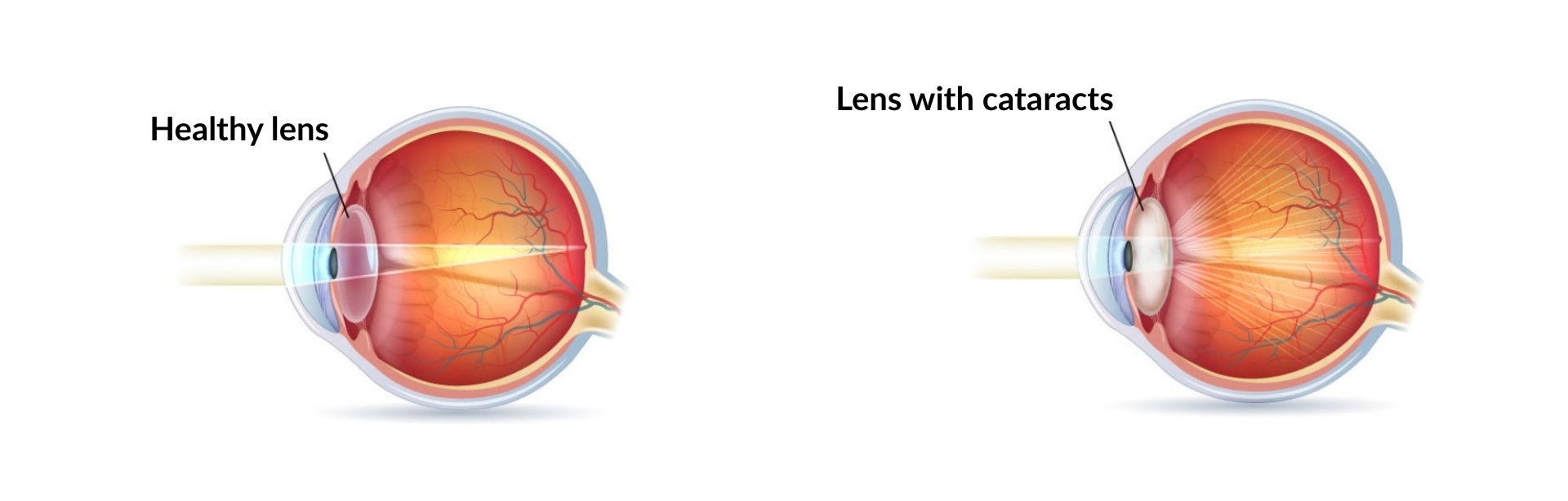

Types of Cataracts
- Age-related cataracts: The most common type of cataract, developing gradually as part of the natural ageing process. They occur when proteins in the lens break down over time, causing progressive clouding that slowly affects vision.
- Nuclear cataracts: Form in the central part of the lens and usually affect distance vision first. Some people may notice a temporary improvement in near vision before overall vision worsens. Colours appear more yellow or less clear as the cataract progresses.
- Cortical cataracts: Develop along the outer edges of the lens and move inward. They are often associated with glare, light sensitivity, and difficulty seeing clearly in bright conditions or at night.
- Posterior subcapsular cataracts: Form at the back of the lens and tend to progress more quickly than other types. They commonly affect reading vision and cause increased glare, especially in bright light or when driving at night.
- Congenital cataracts: Present at birth or develop during childhood. They are related to genetic factors or conditions during pregnancy and can vary in severity, with some requiring early treatment to support normal vision development.
Normal Vision
Loss of Peripheral Vision
How Cataract Surgery Is Performed?
Standard Cataract Surgery
Cataract surgery involves removing the clouded natural lens and replacing it with a clear artificial intraocular lens (IOL) to restore vision clarity. The procedure is performed under local anaesthesia and sedation. A keyhole wound at the peripheral cornea is created, followed by an opening in the lens capsule to access the cataractous lens. The lens matter is then broken down with ultrasound energy using a phacoemulsification probe. These pieces are removed through the same probe, before the IOL is inserted and positioned to remain in the eye. If a toric, multifocal or EDOF lens is inserted, the precise position of the lens implant is confirmed with computer-guidance so that optimal visual quality can be achieved.
Bladeless Cataract Surgery
In some cases, laser-assisted (bladeless) cataract surgery can be used to support certain steps of the procedure. This approach uses a femtosecond laser device to create precise incisions, open the lens capsule, and soften the cataract before removal.
Bladeless cataract surgery has several advantages. As it allows less ultrasound energy to be delivered in the eye, dissipation of the energy to other eye structures, such as the cornea, is minimized. This would be advantageous for more complex cataract cases, such as in a dense cataract, corneal compromise, or eye with angle closure. A bladeless technique allows more precise wound incisions and also the capsule opening, facilitating better astigmatism control and lens placement, which in turn contribute to a more reliable refractive outcome.
Advantages of Bladeless Cataract Surgery
- Uses less ultrasound energy, reducing stress on surrounding eye structures such as the cornea
- Particularly beneficial for complex cataract cases, including dense cataracts and eyes with corneal or angle concerns
- Allows more precise incisions and capsule opening
- Facilitating better astigmatism control and lens placement
- Contributes to more predictable visual outcomes
A bladeless technique is however not required for every patient and is considered based on individual eye anatomy, cataract characteristics, and surgical planning. The choice of technique is discussed during consultation to determine the most appropriate approach for each patient.
Standard vs Bladeless (Laser-Assisted) Cataract Surgery
Standard Cataract Surgery
- Uses fine surgical instruments to create incisions and access the cloudy lens
- The cataract is manually broken down and removed before the intraocular lens is inserted
- Widely performed and suitable for most patients
Bladeless (Laser-Assisted) Cataract Surgery
- Uses a femtosecond laser to assist with selected steps such as incisions, opening the lens capsule, and softening the cataract
- Support greater consistency and precision for certain surgical steps
- Considered based on individual eye anatomy, cataract type, and surgical planning
"Successful cataract surgery goes beyond removing the cloudy lens. Precise measurements, personalised lens selection, and refined surgical technique are essential to achieving clear, comfortable vision at various distances."
— Dr Errol Chan —
Medical Director & Senior Consultant Ophthalmologist
Ascend Eye Clinic, Singapore
Benefits of Cataract Surgery
Whether it is standard or laser-assisted surgery, cataract surgery is performed to address vision impairment caused by a clouded natural lens by replacing it with a clear artificial lens. After cataract surgery, patients experience significant and meaningful improvements in how they see and function in daily life
- Improves vision clarity by replacing the cloudy natural lens with a clear intraocular lens.
- Helps support greater independence in daily activities such as reading, recognising faces, and, where appropriate, driving.
- Reduce the risk of trips and falls by improving overall visual awareness, particularly in older adults.
- Provides long-lasting results, as cataracts do not return once the clouded lens has been removed, although treatable lens capsule clouding may occur later.
The most suitable option depends on the individual’s eye health, specific eye conditions, lifestyle preferences, and visual needs. At Ascend Eye Clinic, we offer patients the full range of intraocular lens implants and various major brands (Alcon, Zeiss, Johnson & Johnson, Bausch & Lomb), allowing lens selection to be tailored to the individual.
Types of Intraocular Lens (IOL) Implants
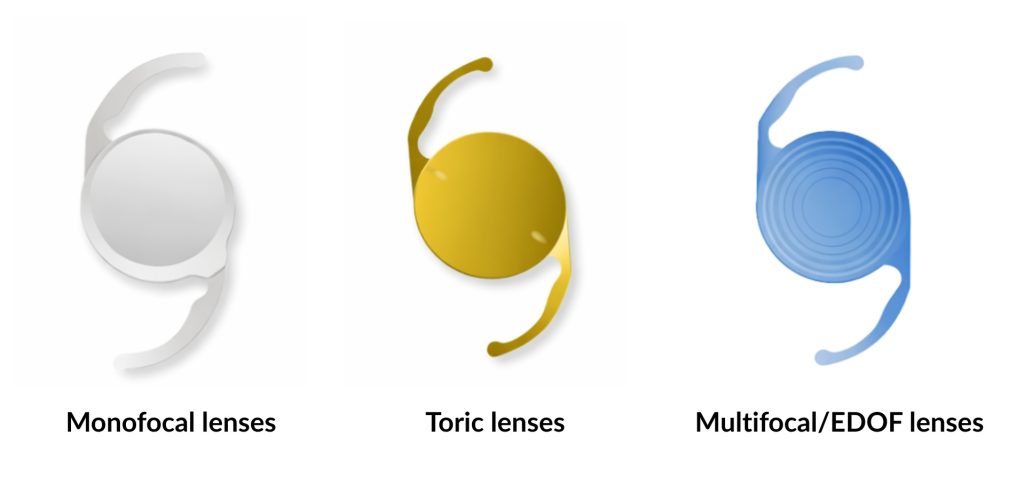
Several types of intraocular lenses (IOLs) are available. Each is designed to support vision at different distances. The most suitable option depends on eye health, lifestyle needs, and visual priorities.
- Monofocal Intraocular Lenses
Designed to provide crisp and clear vision at a single focal distance, usually with each eye targeted for distance vision. In these cases, glasses are typically still needed for near tasks such as reading or close-up work. Some individuals prefer not to use reading glasses and so these can be customized for near distance instead. Such individuals would however need glasses for distance. Monofocal intraocular lenses can be customised in a “blended vision” fashion, where one eye is targeted for distance, and the other eye for near. - Multifocal Intraocular Lenses
These lens implants have the widest focusing range, designed to provide clear vision at near, intermediate, and distance ranges by using multiple focal points within the lens implant. These lenses allow maximal reduction of dependence on glasses for everyday activities, although some patients may notice glare or halos, especially in low-light conditions. An important pre-requisite for a multifocal implant is a healthy eye without glaucoma, macular conditions, prior laser vision correction, or dry eye. - Extended Range of Vision (EDOF) Intraocular Lenses
These may be an option for individuals who are not suitable candidates for multifocal lens implants. EDOF lens implants are designed to provide a continuous range of focus, mainly for distance and intermediate vision, with near vision to the larger font sizes. Reading glasses are required for smaller font sizes. They therefore have a shorter overall focusing range than multifocal lenses. Their advantage compared to multifocal lenses is that they give fewer visual disturbances. To extend. - Premium Monofocal Intraocular Lenses
These implants give clear and crisp vision at a single “extended” focal point, and providing slightly more range of vision than a pure monofocal. When they are used in “blended vision”, they allow the individual not to have to use glasses for distance and reading. - Toric Intraocular Lenses
Designed for patients with astigmatism. All lens implant types, i.e. monofocal, premium monofocal, EDOF and multifocal lenses all have non-toric and toric versions. Toric versions are employed should the individual eye have astigmatism that requires correction. These lenses correct astigmatism at the time of cataract surgery, helping improve overall visual clarity and reduce reliance on glasses for distance vision.
Customising Cataract Surgery and Lens Selection
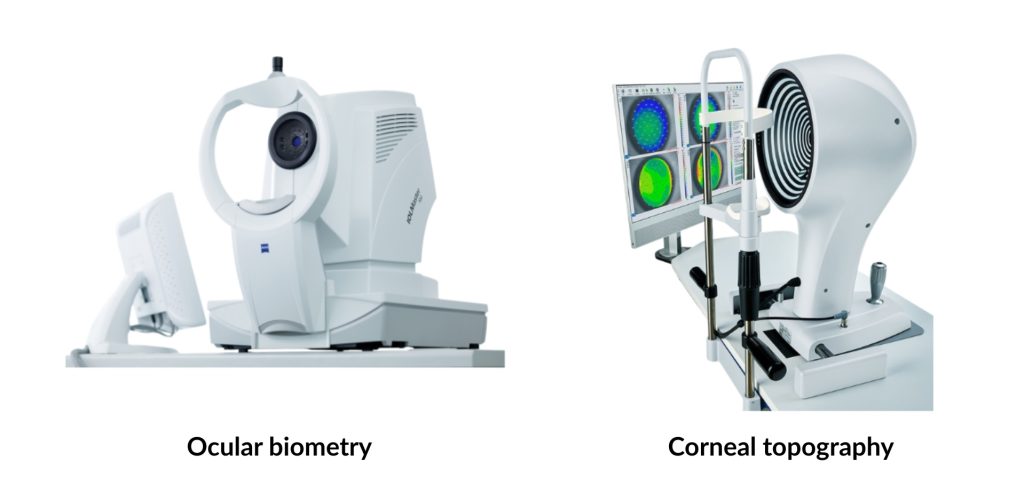
Cataract surgery is planned individually for each patient. Intraocular lens selection is based not only on prescription, but also on eye health, corneal measurements, astigmatism, and how the eyes work together.
Lifestyle considerations are also important. Reading habits, screen use, driving needs, and expectations around glasses are discussed during consultation to help guide lens choice. In some cases, different lenses or focus targets may be planned for each eye to support a broader range of vision.
This customised approach helps align surgical planning with visual goals, while maintaining safety, accuracy, and realistic expectations for the outcome.

Insurance Considerations
Hospitalisation insurance generally covers the surgical component of cataract treatment (i.e., removal of the cloudy lens) and the cost of a standard monofocal lens implant. However, premium lens implants such as multifocal, extended depth of focus (EDOF), toric or premium monofocal implants are not usually covered and a top-up fee would be required that is borne by the patient.
These lenses are considered elective enhancements designed to support a wider range of vision or correct astigmatism. Any additional costs related to premium lens selection are usually discussed during consultation, so patients can make informed decisions based on visual goals and budget considerations.
Cataract Surgery Aftercare
After cataract surgery, following post-operative instructions is important to support healing and reduce the risk of complications. Recovery timelines vary between individuals, and your ophthalmologist will provide guidance based on your condition and progress.
Cataract Surgery Aftercare
Use this timeline as a quick guide to know what to do & what to avoid, as your eyes heal.
Rest your eyes, limit screen time, avoid reading.
Can resume driving or work once your vision is stable.
Light exercise but avoid heavy lifting. You may take a flight with your surgeon’s clearance.
You may use eye make-up, taking care not to get irritation.
Avoid direct tap water contact with the eyes.
Wear eye shields at night to prevent accidental rubbing.
Able to resume full exercise.
Avoid sauna and swimming.
The Importance of Experience and Precision in Cataract Surgery
Cataract surgery outcomes depend on accurate assessment, precise surgical technique, and careful decision-making, particularly when premium intraocular lenses or astigmatism correction are involved.
At Ascend Eye Clinic, cataract surgery is managed by Dr Errol Chan, whose clinical and surgical expertise was honed from a broad international exposure across healthcare systems and in renowned institutions in Singapore, UK and Canada. His clinical and surgical experience positions him to manage complex and high-risk cataract cases, eyes with co-existing conditions such as glaucoma, retinal or corneal issues, or patients with specific visual goals that require careful and meticulous lens selection, surgical planning and execution.
“In all cataract procedures performed at Ascend Eye Clinic, we place a strong emphasis on precision, safety, and individualised planning, forming our commitment to every patient. This is particularly relevant for patients travelling from overseas, where clear planning and predictable outcomes are important.”
— Dr Errol Chan —
Medical Director & Senior Consultant Ophthalmologist
Ascend Eye Clinic, Singapore
About Dr Errol Chan
Dr Errol Chan is the Medical Director and Senior Consultant Ophthalmologist at Ascend Eye Clinic in Singapore. With more than 18 years of clinical and surgical experience and over 10,000 eye procedures performed, he provides comprehensive care for patients seeking treatment for a broad range of complex and routine eye conditions, including age-related vision changes such as presbyopia.
In the area of cataract and lens surgery, Dr Chan performs the full spectrum of procedures, with specific clinical expertise in premium lens implants, to help patients achieve their visual goals of spectacle independence. He performs cataract surgery for complex and high-risk cataracts, cataract surgery in conjunction with glaucoma or retinal surgery.
Dr Chan received his medical degree (MBBS) from the National University of Singapore and completed Ophthalmology specialist training at the National University Hospital in Singapore. He has also achieved Ophthalmology specialist accreditations at the Royal Colleges in Edinburgh, Glasgow, London, and Canada, and the Academy of Medicine, Singapore.
Dr Chan received international fellowship training at the world-renowned McGill University in Canada, and at Moorfields Eye Hospital London in the UK. Additionally, he has furthered his interests in cataract & refractive surgery, and in premium lens implants at Optegra Eye Hospital London, UK.
He is an international speaker, has published more than 40 articles in international peer-reviewed journals, won several international awards, and is an active clinical investigator in clinical trials investigating new treatments for eye diseases.
In his clinical practice, Dr Chan focuses on precision, efficacy, safety, and patient-centred care, adopting a detailed approach from the very first consultation, during surgery, and in follow-up care. Understanding that seeking treatment for an eye condition can be stressful, he affords sufficient time for every patient to understand their aspirations for their vision and their preferences regarding treatment.
Dr Chan regularly treats international patients, including those from Indonesia, who seek evaluation and treatment for cataracts in Singapore. A large number of his patients seek treatments to be free from both distance and reading glasses. Consultations and treatment options are clearly explained, with Bahasa Indonesia support available to help patients understand suitability, expectations, and long-term visual planning.
Frequently Asked Questions (FAQs)
1. Is cataract surgery painful?
Cataract surgery is usually done under local anaesthesia, so most patients do not feel pain during the procedure. Mild irritation or discomfort can occur during early recovery.
2. How do I book a consultation?
You can reach out to our clinical team to arrange a consultation visit and we will assist you in preparing for your visit in Singapore.
3. Will I still need glasses after cataract surgery?
Whether an individual requires glasses after surgery depends on the type of lens implant selected, and other specific factors unique to the individual’s eye. At Ascend Eye Clinic, at minimum, all patients after cataract surgery will not require glasses for distance. For near vision tasks, almost all patients who have had premium lens implants will not require reading glasses.
Finally, for patients with very specific activity requirements, e.g., sewing, may require reading glasses for those specific tasks.
4. Can cataracts come back after surgery?
Cataracts do not return once the cloudy lens is removed. However, some patients may develop lens capsule clouding later, which can be treated with a simple outpatient laser procedure if needed.
5. What is the difference between standard and premium intraocular lenses?
Standard lenses usually correct vision at one distance. Premium lenses are designed to support a wider range of vision or correct astigmatism, reducing dependence on glasses for daily activities.
6. How is the intraocular lens chosen for each patient?
At Ascend Eye Clinic, we will discuss suitable lens implant options during the consultation visit.
7. How long do I need to stay in Singapore for cataract surgery?
Most patients stay a few days in Singapore for consultation, surgery, and initial follow-up before returning home.
8. When is it safe to fly back to Indonesia after cataract surgery?
Many patients can travel within a few days after surgery once the eye is stable. Your surgeon will advise the safest timing based on recovery.
9. Will I need to stay overnight in the hospital after cataract surgery?
Cataract surgery is typically a day procedure. Overnight stay is usually not required unless there are specific medical considerations.
10. Does insurance cover premium intraocular lenses?
Hospitalisation insurance generally covers the surgical component of cataract treatment (i.e., removal of the cloudy lens) and the cost of a standard monofocal lens implant. However, premium lens implants such as multifocal, extended depth of focus (EDOF), toric or premium monofocal implants are not usually covered and a top-up fee would be required that is borne by the patient.
To learn more or schedule your consultation, contact our Indonesia office via WhatsApp. We’re here to help you.