


If straight lines start to look wavy, words become harder to read, or the centre of your vision turns blurry or distorted, it may be a sign of a retinal condition that should not be ignored. With accurate diagnosis and timely management, including retinal surgery when appropriate, many patients are able to improve their vision.
Dr Errol Chan, an experienced retinal specialist and surgeon in Singapore, provides specialised surgical care for patients with macular holes and epiretinal membranes to restore and improve their vision.
What is a Macular Hole?
A macular hole is a small opening that forms in the macula, the central part of the retina responsible for sharp, detailed vision. It most commonly develops due to age-related changes when the vitreous gel inside the eye shrinks and pulls away from the retina. This traction creates a hole in the macula.
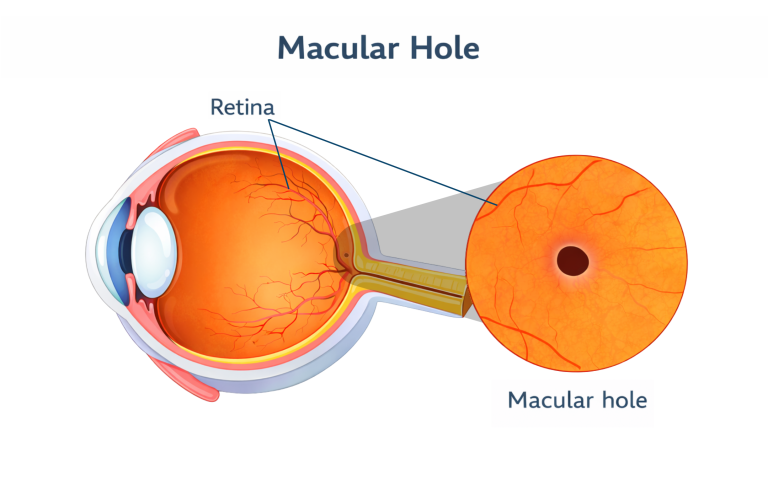
Symptoms of a Macular Hole
Patients with a macular hole may experience:
- Blurred or reduced central vision
- Distortion, where straight lines appear bent or wavy
- A dark or empty spot in the center of vision
- Increasing difficulty with reading or detailed work
- Difficulty with judging distances with both eyes
Without treatment, vision loss will gradually worsen.
Risk Factors for Macular Holes
Macular holes are most commonly associated with ageing, as the vitreous gel causes traction on the macula over time. Certain factors increase the risk, including:
- Increasing age
- Female sex
- High near-sightedness (high myopia)
- Previous eye injury or trauma
- Eye inflammation, such as uveitis
- Prior eye surgery
- Chronic leakage in the macula (e.g. due to wet macular degeneration)
People with these risk factors should seek early assessment if they notice distorted or blurred central vision, as timely treatment can help preserve visual function.
What is an Epiretinal Membrane?
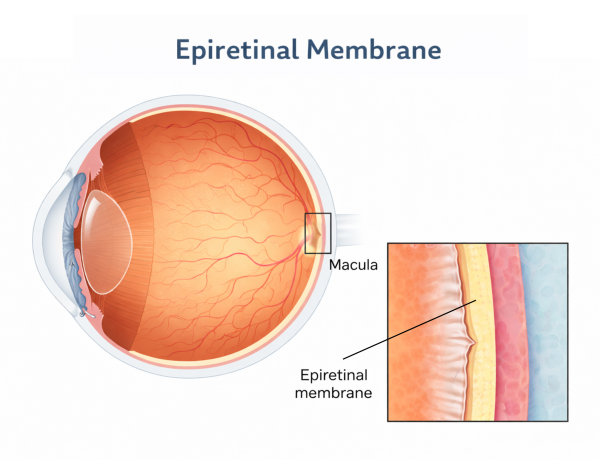
Symptoms of an Epiretinal Membrane
Common symptoms include:
- Blurred central vision
- Visual distortion or warping of objects
- Difficulty reading or recognizing faces
- Vision that feels “out of focus” even with glasses
- Difficulty with judging distances with both eyes
Symptoms start mildly but can progress over time.

"The successful management of retinal conditions such as macular hole and epiretinal membrane benefits from advanced and precision retinal imaging and refined microsurgical techniques. With these, we can treat patients with macular holes or epiretinal membranes to achieve significant improvements in their vision and resulting day-to-day functioning."
— Dr Errol Chan —
Medical Director & Senior Consultant Ophthalmologist
Ascend Eye Clinic, Singapore
Treatment Options
Treatment depends on how much the condition affects your vision and daily activities. Both macular holes and epiretinal membranes are managed based on symptom severity, progression, and retinal findings from detailed eye scans. When visual changes interfere with reading, driving, phone usage or computer work, and other day-today social or occupational activities, retinal surgery is the most effective treatment.
Macular Holes
For macular holes, surgery is usually recommended once the diagnosis is confirmed because they do not reliably heal on their own, and central vision worsens over time. The standard treatment is vitrectomy with internal limiting membrane peeling, which relieves traction on the hole and allows it to close. Prior to the end of surgery, gas or oil is placed into the vitreous cavity, as when the patient maintains a face down or cheek to side position for a few days, the bubble supports the hole closure and accelerates recovery. For patients with large macular holes, other adjunctive surgical techniques can be performed to increase the chances of successful hole closure and restoration of vision. After surgery, the improvement in clarity is noticeable, and continues up to 6 months.
Epiretinal Membranes
For epiretinal membranes, treatment starts with observation if symptoms are mild and daily activities are not affected. However, if blurring or distortion becomes more noticeable, especially when reading or recognising faces, surgery is the preferred option. The definitive treatment is vitrectomy with membrane peeling, which relieves traction on the macula and reduces visual distortion. Towards the end of surgery, an air or gas bubble may be placed, to help improve the overall retinal contour and help in healing. After surgery, visual distortion is typically noticeably improved, and further improvements in clarity continues to be achieved up to 6 months.
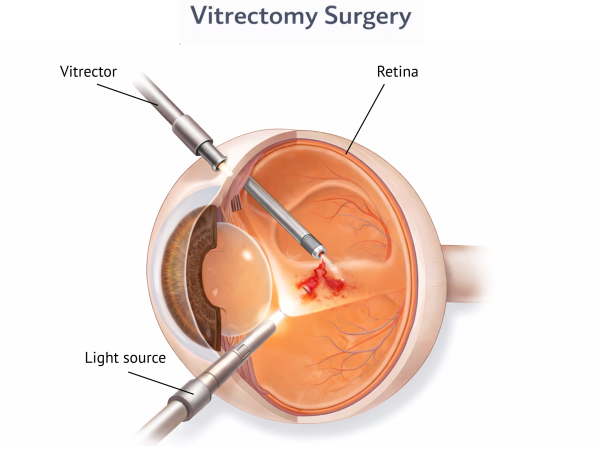
What is Involved in Retinal Surgery
Retinal surgery for macular holes and epiretinal membranes is performed through a minimally-invasive procedure called vitrectomy. This is a microsurgical “keyhole” operation that allows the surgeon to safely access and treat the macula at the back of the eye.
The surgery typically takes about 45 to 60 minutes. The vitreous gel inside the eye is removed to relieve traction on the retina, which can otherwise distort the macula. This procedure is performed under controlled surgical conditions, and with fine instruments to gently remove membranous tissue from the retina.
For macular holes, the internal limiting membrane, the innermost layer of the retina, is gently peeled and removed, and a gas or oil bubble is placed in the eye. When the patient adopts a specific face down or cheek-to-side position, this supports closure of the hole as the macula heals.
For epiretinal membranes, the thin membrane on the surface of the macula is gently peeled away, reducing distortion of the macula.
Benefits of Retinal Surgery
Retinal surgery treats the underlying structural problem in the macula, which is the main cause of vision loss in macular holes and epiretinal membranes. Surgery significantly improves visual function and prevents long-term damage. The key benefits of surgery are that it:
- Improves or restores central vision affected by macular holes
- Reduces visual distortion caused by epiretinal membranes
- Prevents further deterioration of macular structure
- Stabilises vision and slows or stops progressive vision loss
- Helps patients read, recognise faces, judging distances, and perform daily activities more comfortably
- Helps restore the natural shape of the macula after traction is relieved
Recovery & Aftercare
Retinal surgery for macular holes and epiretinal membranes is usually performed as a day surgery, meaning most patients can return to their accommodation on the same day without requiring an overnight hospital stay.
For overseas patients from Indonesia, it is generally advisable to plan a stay in Singapore of several days to about one week, depending on the type of surgery performed and early post-operative reviews. This allows time for follow-up checks, medication adjustments, and guidance on eye care before flying home. With proper aftercare and clear instructions, most patients are able to recover comfortably and safely after returning to Indonesia.
Retinal Surgery Aftercare
Use this timeline as a quick guide to know what to do & what to avoid, as your eyes heal.
Avoid direct water contact with the eye
Avoid rubbing or pressing on the eye
Head positioning may be required, as part of the recovery. If an air or gas bubble is present, no air travel until bubble disappears
If no head positioning is required beyond this time, can resume light activities, but avoid heavy lifting or strenuous workouts
Can resume swimming and strenuous activities
Full improvement can be realised after 6 months after surgery
About Dr Errol Chan
Dr Errol Chan is the Medical Director and Senior Consultant Ophthalmologist at Ascend Eye Clinic Singapore, with a subspecialty focus on medical and surgical retinal diseases, including macular holes and epiretinal membranes.
With more than 18 years of clinical and surgical experience and over 10,000 eye procedures performed, Dr Chan provides comprehensive and individualised care for patients with routine and complex eye diseases, from early diagnosis to longer-term management.
Dr Chan obtained his medical degree (MBBS) with Distinction from the National University of Singapore and completed his ophthalmology specialist training at the National University Hospital, Singapore. He holds Ophthalmology specialist accreditations from the Royal Colleges in Edinburgh, Glasgow, London and Canada, as well as the Academy of Medicine, Singapore.
Dr Chan is an international triple fellowship-trained specialist in retinal diseases and retinal surgery. He was awarded a scholarship by the Retina Foundation of Canada to pursue a Vitreoretinal Surgery Fellowship at McGill University, Canada, and has also completed Advanced Vitreoretinal Surgery and Medical Retina & Uveitis Fellowships at the world-renowned Moorfields Eye Hospital London, UK.
In the management of macular holes and epiretinal membranes, Dr Chan holds expertise in surgery for routine and complex cases, such as cases with previously failed surgeries, large or traumatic macular holes, and macular holes or epiretinal membranes in highly myopic (nearsighted) eyes, or eyes with concurrent retinal diseases. His management approach emphasises meticulous assessment, clinical and surgical excellence, leveraging on forefront technology, in order to provide the most optimal outcomes for patients.
As a retinal specialist, Dr Chan manages various medical and surgical retinal diseases, such as macular degeneration, diabetic eye disease, retinal detachment, retinal vascular and choroidal diseases, uveitis and inherited retinal conditions. He frequently provides second opinions on challenging retinal conditions, including those involving Indonesian patients.
Dr Chan has authored more than 40 peer-reviewed journal publications and textbook chapters, presented at international Ophthalmology conferences, and participated as an investigator in international clinical trials advancing treatments for retinal disease. His work has been recognised with multiple international awards, including accolades from the Asia-Pacific Vitreoretinal Society.

Frequently Asked Questions (FAQs)
1. When should I see a retinal specialist?
You should seek specialist care if you notice blurred or distorted central vision, straight lines appearing wavy, difficulty reading, judging distances, or recognising faces. Early assessment and diagnosis is important because recovery of vision is better if the condition is treated early.
2. How is a macular hole diagnosed?
3. Will my vision continue to worsen if I delay treatment?
In many cases, untreated macular holes lead to progressive central vision loss. For some patients with epiretinal membrane, progression occurs gradually but with a definite worsening in vision. Early assessment helps determine the appropriate timing for treatment before permanent changes occur.
4. Is retinal surgery safe?
Retinal surgery in the form of vitrectomy and membrane peeling is a well-established procedure performed using advanced microsurgical techniques. When performed by an experienced retinal specialist and surgeon, it has a strong safety record.
5. What factors affect the success of macular hole surgery?
Surgical outcomes depend on factors such as the size of the macular hole, how long it has been present, and overall retinal health. Chronic or large macular holes, whilst being treatable with current surgical techniques, may not recover as much vision after treatment as more recent holes. This emphasizes the importance of having macular hole treatment earlier rather than later.
6. Will I need to position my head after surgery?
In general, if air, gas or oil is placed in the eye, then the patient would need to adopt a specific face down or cheek-to-side head positioning for a duration between 1 day to 1 week. We will provide clear, individualised instructions.
7. Will I be able to see immediately after retinal surgery?
If a gas or oil bubble is placed in your eye, your vision will be blurry during the time that the bubble is present. In the case of gas, as the bubble is gradually absorbed, your vision will improve. If silicone oil is placed, this will cause a shift in your spectacle prescription, and depending on the value, glasses may be able to assist you to see better, whilst the oil is present in the eye. When the oil is removed, you will achieve your final longer-term vision.
8. Is retinal surgery performed as a day procedure?
9. How do Indonesian patients arrange consultations and treatment in Singapore?
Indonesian patients can contact our WhatsApp contact number and our team will be able to assist you with questions you have on your condition and treatment, appointment scheduling, treatment planning and travel coordination.
10. Is Bahasa Indonesia support available during my treatment journey?
To learn more or schedule your consultation, contact our Indonesia office via WhatsApp. We’re here to help you.